
Whether the loss of a loved one occurs from a sudden accident, mass shooting, natural disaster, war, or disease, grief is often overwhelming for those left behind.
How do we learn to live with the pain of tragedy and loss? And how do we help ourselves and our children cope with grief in the most restorative way possible?
Following the death of my husband, I began to reflect on life’s terrors and abysses —about the painful challenges we are often asked to endure. Most of all, I hated the fact that my three-year-old daughter would have to grieve throughout her childhood for a father she would likely never remember.
The World in a Grain of Sand
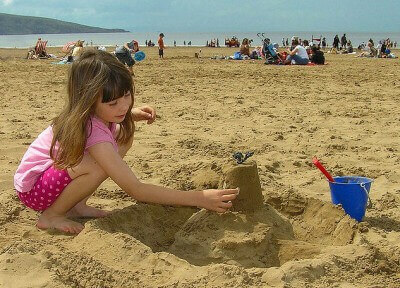
A few months after Richard’s death, my daughter Sarah and I took a trip to the beach for some needed rest and recuperation. As I watched Sarah build one of her first sandcastles, I discovered a gift which would eventually lead both of us on our mutual journeys through grief.
With the help of our good friend Diane, Sarah worked diligently to build the perfect sandcastle. Diane, a dynamic preschool teacher, encouraged Sarah to be very creative with her castle. I watched her take great pride in shaping each room and each mounded tower as the castle slowly began to take its form. The joy and excitement of accomplishment was written all over Sarah’s face. By the time the castle was complete, it had a moat, several tunnels, rooms of all shapes and sizes and, most of all, castle-like elegance.
As I observed the gratifying process of watching a three-year-old build a sandcastle, I was keenly aware of my husband’s absence. Like me, he loved to watch Sarah play and took great pride in each of her new accomplishments. I felt devastated by his loss and so alone in my grief. Then, in the moment of my deepest pain, an enormous wave crashed on the beach and demolished Sarah’s beautiful castle.
Like the normal child she was, Sarah reacted to the loss of her sandcastle with shock and anger. With tears streaming down her cheeks, she ran to me for comfort from this sudden disaster. Outraged, she vowed never to build a sandcastle again! What she wanted most at that moment was the safe shelter of her mother’s arms.
But Diane wasn’t willing to let my daughter off the hook so easily. She walked over to where Sarah and I were sitting and began to explain the nature of sandcastle-building. “Sarah,” she said, “Part of the joy of building a sandcastle is that, in the end, we can give it as a gift to the ocean.”
“This is what building sandcastles is all about,” Diane said. “It lets us be gift-givers.”
Sarah loved the idea of giving gifts and immediately responded with enthusiasm to the thought of building another sandcastle. Her tears instantly turned to a smile. This time she wanted to build her castle even closer to the water, so the ocean would get its gift sooner!
Grief as a Gift-Giving Process
As I watched Sarah and Diane build and lose their castle, I began to see a parallel to Richard’s death – to how we rebuild our own lives through grief. I visualized the castle as his life and the crashing wave as his death. I was shocked and angry when his castle was abruptly washed away. I, too, wanted the shelter and loving comfort of someone’s arms – my husband’s.
What I had missed until that moment was the concept that grief could be a gift-giving process. Just as the sandcastle was a gift to the ocean, Richard’s life was a gift to me, Sarah, and all who loved him. My memories, like the sand on the shoreline, were in front of me — waiting to be touched and felt, ready to be used as building material in the healing process ahead.
Reshaping our life in periods of change is not an unfamiliar process. Like a sandcastle, we constantly shift, recreate, and remold ourselves as we are influenced by our families, friends, and environment. As we grow, we make choices to add new rooms and eliminate others. We build tunnels and bridges to connect our life with helpful people; we build walls and moats to protect ourselves from harm.
Frequent storms and crashing waves re¬shape our castles from time to time. When a storm passes, we often take time for retreat and reflection. Some¬times we choose to make changes to our sandcastle — striving to make it a little closer to our own views of perfec¬tion.
I asked myself, “To what end do we continually transform our sandcastle if it will be forever lost to the ocean?”
That day I realized that although our lives are eventually washed away, the granules of our lives remain on the shoreline – they do not disappear. Those granules of sand still exist, as a source of strength and renewal for those left behind. They become building materi¬al for new and restored sandcastles to come.
When we remem¬ber famous people like Martin Luther King or John F. Kennedy, we can easily touch and feel the sands of their lives. Young people march in celebra¬tion of King’s birthday, filled with his ideas and strength. Their attitudes and behavior have been born through grief, through the simple yet empowering process of remembering someone who died.
Remembering and Rebuilding: Dual Aspects of Grief
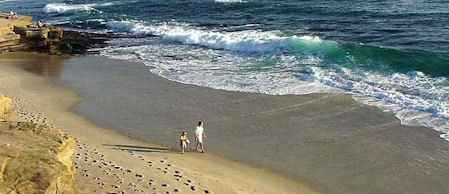
Each life, from the most famous to the most obscure, is a meaningful part of a family touched by love. Grieving, then, becomes the process of standing at the shoreline, sifting through each granule of sand, remembering the person we loved. As we touch and feel each tiny piece of sand, we make choices to keep some granules and let go of others. The gifts we hold closely help rebuild our own sandcastle – temporarily devastated by our grief.
I returned from our day at the beach with a new perspective on grief. I wanted to keep the art of sandcastle building closely in mind as I began to use the gifts of Richard’s love to rebuild our lives.
For the first time, I recog¬nized the building material was right in front of us. Sarah and I began to look at our memories as a rich source of strength and courage instead of as an anchor to our sorrow. I under¬stood the grief process would take a long time, that there were thousands of grains of sand to be closely examined. That simple realization gave me the patience to endure – to search for the large and small gifts from Richard’s life.
Yes, I felt numb and afraid. Yet I was much more willing to tackle this awkward and confusing emotion we call grief. Together, Sarah and I remembered. Our families shared stories, over and over again throughout the years ahead. And indeed, those memories slowly helped us rebuild our lives.
Sarah is now a young adult. She and I are fortunate to share the love of a man I married four years later and to whom she calls “Papa.” But she also knows and loves her father in ways I would never have imagined at the time of his death. The gift of Richard’s sandcastle will always be part of who we are.
For other families coping with grief, you can help yourselves and your children by remembering the granules of the cherished life you loved and lost. Use those grains of sand to rebuild your own sandcastle so that someday your life will be forever etched in the hearts of those you love.
Images by Dave Rogers; Coba; Public-Domain-Image.Com
Published: July 30, 2012
Tags: character strengths, empathy, grieving, parenting, positive youth development, Spirituality