
What are character strengths? What meaningful role does character play in child and adult development?
It is widely acknowledged that character –not beauty, high test scores, or wealth–account for life satisfaction and well-being. Derived from the field of positive psychology, the term character strengths has become synonymous with a group of 24 unique human characteristics developed by the VIA Institute on Character. Research suggests these attributes impact happiness, including our development of resilience and positive relationships.
How do children develop character strengths during their academic climb from kindergarten through high school? Educational goals of developing intelligence are well articulated and their outcomes can be measured. Until now, however, character strengths were less defined and not as measurable.
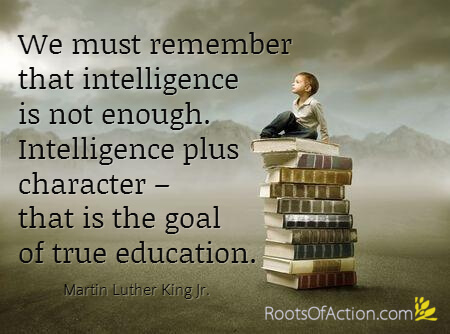
Martin Luther King Jr. understood the concept of character strengths long before they were as well-defined as they are today. At a speech at Morehouse College in 1948, he said, “We must remember that intelligence is not enough. Intelligence plus character–that is the goal of true education.”
When I reflect on King’s statement, I think of my closest friends and the people I most respect. I am drawn to them by forces beyond intellect and external success. I admire their character strengths, the values they hold, and how they put their values into action. When we consider the role of families, schools, and communities in the broadest sense, it is important to understand how each of these stakeholders helps kids develop character strengths during childhood and adolescence that determine the kind of adults they will become.
This article defines character strengths and summarizes a framework for understanding them. As adults who model character to kids each and every day, it’s helpful to begin by taking inventory of our own character strengths!
Character Strengths Count Throughout Life
While researchers are not in total agreement, there has been effort in recent years to define and measure character strengths.
In their highly acclaimed academic textbook, Character Strengths and Virtues: A Handbook and Classification, Christopher Peterson and Martin Seligman attempt to define these inner virtues and strengths. Research suggests that “people who use these inner strengths every day are three times more likely to report having an excellent quality of life and six times more likely to be engaged at work.” You can read extended definitions of all these strengths at the nonprofit VIA Institute on Character, but simply put, they fall into the following six categories:
- Wisdom and Knowledge: Creativity, Curiosity, Judgment and Open-Mindedness, Love of Learning, Perspective
- Courage: Bravery, Perseverance, Honesty, Zest
- Humanity: Capacity to Love and Be Loved, Kindness, Social Intelligence
- Justice: Teamwork, Fairness, Leadership
- Temperance: Forgiveness and Mercy, Modesty and Humility, Prudence, Self-Regulation
- Transcendence: Appreciation of Beauty and Excellence, Gratitude, Hope, Humor, Religiousness and Spirituality
It’s important to note that this is one framework used to understand character strengths. I like the VIA Institute Model because it is easy to understand and backed by lots of empirical research. Some scholars argue that these character strengths are not new, but an adjunct to what we have learned by studying personality theory for decades. Every model has limitations and it’s best to consider them helpful guides rather than bibles for living a full and happy life.
The value of any kind of framework is in how it is understood and applied in the real world–in homes, classrooms, and out-of-school-time activities for children. That link from theory to practice is at the heart of our articles at Roots of Action.
Getting Started: Understanding Your Character Strengths
 One of the best ways for parents, educators, and community leaders to better understand character strengths is by first examining your own. I did this and so can you! More than seven million people worldwide have taken the online survey through the VIA Institute on Character.
The survey for adults takes 30-40 minutes and produces a free report of your top five strengths. There is also a survey designed for youth ages 11-17 that takes 40-50 minutes. If you want more detailed reports of your 24 character strengths, fees vary from $10-$40.
A few years ago, my daughter and I took the survey. I opted for the free version which listed my top five strengths and what they mean. Mine were:
- Appreciation of beauty and excellence – You notice and appreciate beauty, excellence, and/or skilled performance in all domains of life, from nature to art to mathematics to science to everyday experience.
- Creativity, ingenuity, and originality – Thinking of new ways to do things is a crucial part of who you are. You are never content with doing something the conventional way if a better way is possible.
- Gratitude: You are aware of the good things that happen to you, and you never take them for granted. Your friends and family members know that you are a grateful person because you always take the time to express your thanks.
- Hope, optimism, and future-mindedness: You expect the best in the future, and you work to achieve it. You believe that the future is something that you can control.
- Industry, diligence, and perseverance: You work hard to finish what you start. No matter the project, you “get it out the door” in timely fashion. You do not get distracted when you work, and you take satisfaction in completing tasks.
Discussing Strengths of Character with Kids
My daughter chuckled at the results of my VIA Quiz, saying they fit me to a tee. “Anyone determined enough to get a Ph.D. in mid-life has to have a lot of ingenuity and perseverance!” she said.
Being in the middle of a job search, my daughter opted for the $40 report which she thought might be helpful in understanding her strengths as they related to a career choice. The 18-page report rank-ordered all of her strengths, not only giving her a top five but also information on how she could develop strengths that she didn’t use as much. It was a very helpful document.
My daughter’s top five strengths were completely different from mine, which was not surprising. Through our conversations, we learned a lot about each other, how we differ, and why we admire each other’s strengths. We agreed that developing character strengths mattered in life!
Want to learn about your own character strengths? Take the VIA Survey of Character. When you have finished, you’ll understand your own strengths and take the first step to learning how to foster character strengths in young people!
Next Steps: Fostering Personality Strengths in Families, Schools, and Communities
Understanding our own character strengths is an important first step to helping develop these strengths in our children:
- Learn how families can develop character by talking about and reinforcing the VIA character strengths from preschool through adolescence. If you hold regular family meetings with children ten or above, the results of the VIA survey make for wonderful conversation and learning!
- Learn why good teachers view character education as half their jobs and how one 4th grade teacher makes character strengths central to his core curriculum.
- Learn how communities support and encourage young people to be their best selves.
[This article was originally published May 6, 2011. It was updated with new information and research May 1, 2019.]
Published: May 1, 2019
Tags: character strengths, parenting, positive youth development, teachers