

Learning to take initiative is a behavior that helps kids navigate their lives with courage and optimism.
Alfred D. Souza makes a great point: “For a long time it had seemed to me that life was about to begin. But there was always some obstacle in the way, something to be gotten through first, some unfinished business, time still to be served, a debt to be paid. Then life would begin. At last it dawned on me that these obstacles were my life.”
Indeed, obstacles are a part of life. And often they seem endless, particularly to children. Kids become happier adults when they learn how to overcome challenges and obstacles–to step up and take initiative and involve themselves in activities that are meaningful to them.
A common refrain I often hear from parents of tweens and teens is, “My son doesn’t take initiative. I don’t know how to motivate him.” “My daughter doesn’t stand up for herself.”
This article provides insights about how children learn to take initiative. Parents and teachers are key mentors in the process.
Why is Taking Initiative Important?
Taking initiative helps propel life forward in purposeful directions. Initiative directs our attention toward a challenging goal and helps us overcome obstacles. Learning to take initiative is an important aspect of positive youth development.
The ability to take initiative is developed in late childhood and adolescence through mastery experiences and relationships that help kids believe in themselves. Since initiative can be used to accomplish good or evil, it also involves instilling positive attributes in childhood, including empathy, self-awareness, and integrity — and other attributes that are part of The Compass Advantage. Whether young people learn to make a positive difference in their own life or in the world around them, taking initiative requires a combination of inner energy and outer action.
The ability to take initiative is developed through internal rewards, like creativity, dignity, autonomy, making a difference for others, and activities that help kids create their own futures. It is not developed through external rewards like grades, winning, awards, and money.
Activities that Help Kids Take Initiative
Researchers have identified three important elements of activities that help children learn to take initiative during childhood and adolescence.
- Kids must choose activities for themselves because it gives them “internal” rewards! Examples include music programs, service-learning, and a myriad of other after-school activities.
- The activity must take place in an environment that contains rules, challenges, and complexities inherent in the real world. Children must face intellectual, interpersonal, and intrapersonal challenges that go beyond grades, winning a game, and other external rewards.
- The activity must be sustained over a period of time. Rather than doing lots of activities, it is better for children to focus on a few for longer periods of time so they learn to persevere despite challenges.
Compelling Facts

- IQ accounts for less than 25% of life success. Emotional intelligence, including taking initiative, accounts for the rest.
- Boredom is the antithesis of taking initiative. Both honor students and those involved in delinquent activities report the highest levels of boredom in the U.S., many more than 50% of the time.
- Kids who lack the ability to take initiative are more prone to depression.
- Children and adolescents who successfully learn to take initiative spend twice as much time in hobbies and sports than kids with low levels and they spend more time with their families.
- Traditional classrooms and homework, activities that account for more than 30% of kids waking hours, have limited potential for learning to take initiative.
Communication Tips for Parents
- When children blame, moan, or whine, turn it into an opportunity to find out what they care about! Uncover hidden convictions that can fuel their ability to take initiative and action in the world.
- Shift from a language of “Prizes and Praising” to a language of “Ongoing Regard.” Instead of giving praise for all the things children “do,” communicate appreciation for who they are.
- Help kids learn to solve their own problems and navigate obstacles. Allow them to fail. Be a mentor to your children as they learn to take initiative and discover interests that motivate them.
Mentoring Fosters Kids’ Ability to Take Initiative
- Be on the sidelines to help facilitate children’s learning.
- Encourage children to get back on their feet after a fall – because you believe in them.
- Be a helpful guide as children identify challenges, reflect on their choices, arrive at decisions, adjust strategies, and plans next steps. Listen and encourage.
- Be a role model. Show them how you get things done but don’t do things for them that they can do for themselves.
I’d love to hear from you about your experiences as parents, educators, and mentors of young people. How have you helped children learn to take initiative? What kinds of activities bring the highest internal rewards? Why? How do classrooms foster initiative?
Infographic on Taking Initiative
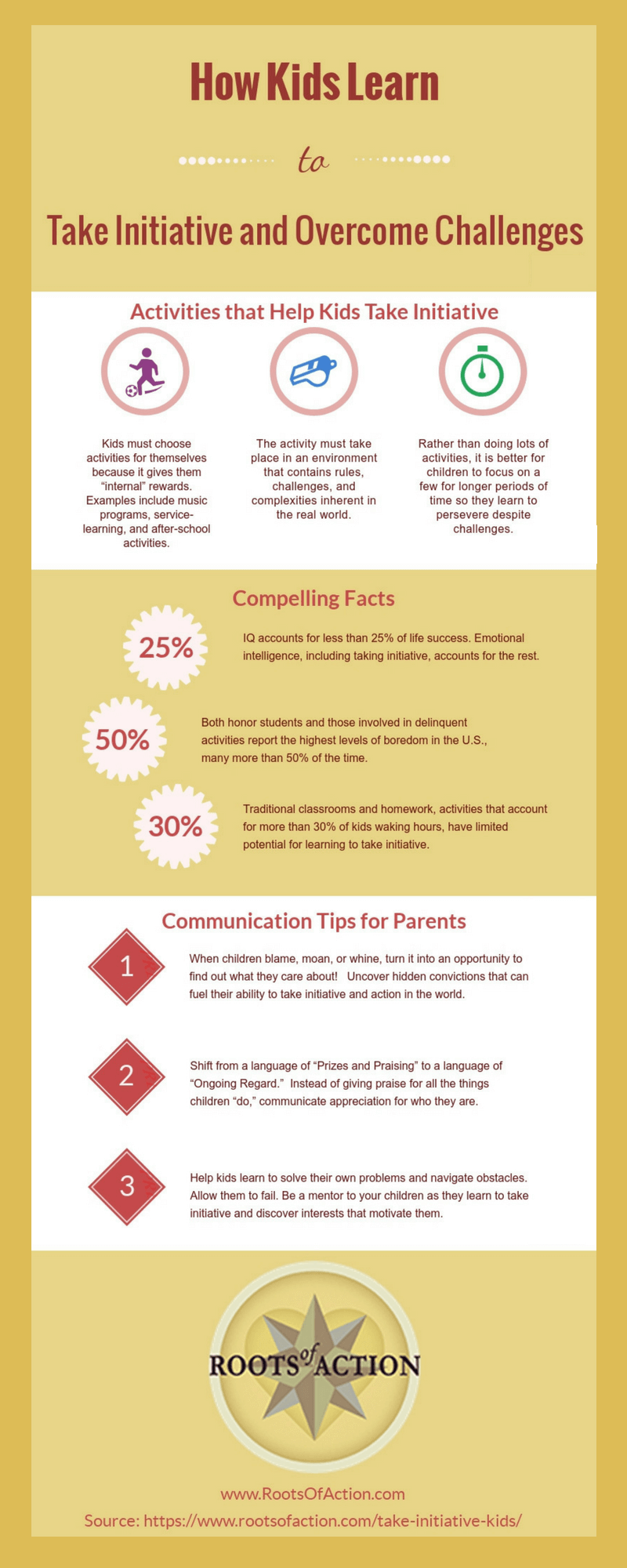
Feel free to use and share the following infographic, synthesized from this article on how children learn to take initiative.
Related Articles:
Successful Kids Need 8 Core Abilities: How to Parent with Purpose
Goal Setters Often Become Peak Performers
Encouraging Words for Kids that Ignite Self Discovery and Growth
References
Adlai-Gail, W. S. (1994). Exploring the autotelic personality. Dissertation, University of Chicago.
Bandura, A. (2001). Social cognitive theory: An agentic perspective. Annual Review of Psychology, 52, 1-26.
Csikszentmihalyi, M. (1997). Finding flow: The psychology of engagement with everyday life (1st ed.). New York: Basic Books.
Goleman, D. (1995). Emotional intelligence. New York: Bantam Books.
Hekmer, J. M. (1996). Exploring optimal personality development: A longitudinal study of adolescents. Dissertation, University of Chicago.
Larson, R. W. (2000). Toward a psychology of positive youth development. American Psychologist, 55(1), 170-183.
(This article was originally published April 28, 2011. It was updated with new research and material June 20, 2018.)

Published: June 20, 2018
Tags: initiative, positive youth development